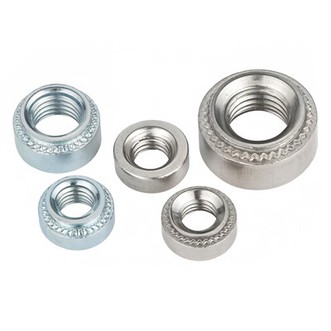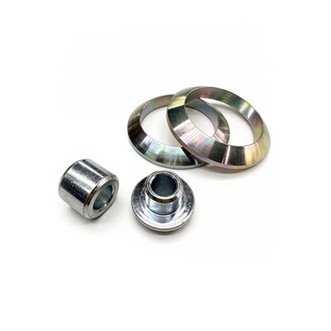

A self-locking nut-also known simply as a nut-is a component screwed onto a bolt or threaded rod to provide a fastening function. It is an essential element required in the manufacture of all types of machinery. Self-locking nuts serve to securely join mechanical equipment; a connection can only be established when a nut and a bolt of matching specifications engage via their internal threads. Below, we detail four methods used to prevent self-locking nuts from loosening.
Mechanical Locking
This method employs specific locking devices (stoppers) to directly restrict the relative rotation between the nut and the bolt. Examples include the use of split pins, safety wire, and locking washers. Since these locking devices do not generate any preload force, they only become effective once the nut has already loosened and backed off to the point where it contacts the stopper. Consequently, this method does not, in practice, *prevent* loosening; rather, it serves to prevent the nut from 'falling off' completely.
Riveting/Staking Locking
After tightening, methods such as staking (punching), welding, or bonding are applied to the nut-and-bolt assembly. This process eliminates the assembly's characteristics as a movable joint, transforming it into a permanent, non-dismountable connection. The drawback of this method is that the bolt can be used only once; furthermore, disassembly is extremely difficult, requiring the destruction of the bolt assembly to separate the components.
Friction Locking
This is the most widely utilized method of preventing loosening. It works by generating a positive pressure between the nut and the bolt-a pressure that remains constant regardless of external forces-thereby creating a frictional force sufficient to resist any relative rotation between the two components. This positive pressure can be achieved by applying compressive force to the nut-and-bolt assembly either axially (along the axis) or simultaneously in both axial and radial directions. Examples include the use of spring washers, double nuts (locknuts), self-locking nuts, and nuts with locking inserts.
Structural Locking
This method leverages the inherent structural design of the nut-and-bolt assembly itself-specifically, the principle embodied by the "Tang's Nut" (or similar structural locking mechanisms).
Edge Staking Locking
After the nut has been tightened, a punch is used to deform or damage the threads at the end of the bolt, thereby preventing the nut from backing off.
Adhesive Locking typically involves applying an anaerobic adhesive to the mating threads; once the nut is tightened, the adhesive cures automatically, providing an effective anti-loosening bond. The disadvantage of this method is that the bolt can be used only once, and disassembly is extremely difficult, requiring the destruction of the bolt assembly to separate the components.