
Shanghai Megood Metal Products Co., Ltd.

Riveting

Industrial Rivets Manufacturer & Supplier | Custom Riveting Solutions


We manufacture solid rivets, semi-tubular rivets, blind rivets, structural blind rivets, and threaded rivet nuts for OEM assemblies and industrial fastening applications. Standard and custom options are available in carbon steel, stainless steel, aluminum alloys, and selected non-ferrous materials, with dimensions, grip ranges, head styles, and surface finishes specified to suit the application.
For build-to-print projects, buyers can submit engineering drawings, joint thickness requirements, material specifications, and applicable standards for technical review and quotation.

 
  • Blind Threaded Rivnut Fasteners

    Blind Threaded Rivnut Fasteners

    When you need to add a load-bearing thread to a thin-walled pipe or a sheet metal panel where you cannot reach the back, our Blind Threaded Rivnut Fasteners are the perfect hybrid solution. They

    Add to Inquiry
  • Bespoke Solid Rivets

    Bespoke Solid Rivets

    Whether you are building heavy-duty luggage, industrial hinges, or mechanical linkages, some applications require a tailored fastening approach. Our Bespoke Solid Rivets include semi-tubular and

    Add to Inquiry
  • High-Strength Press-In Nuts

    High-Strength Press-In Nuts

    For automated assembly lines where downtime is not an option, our High-Strength Press-In Nuts are engineered for flawless performance. Unlike standard fasteners that can jam in vibration bowls, our

    Add to Inquiry
  • Self-Clinching Threaded Studs

    Self-Clinching Threaded Studs

    Why settle for the mess and heat of welding when you can have a perfectly perpendicular threaded post installed in seconds? Our Self-Clinching Threaded Studs are designed to be pressed into ductile

    Add to Inquiry
  • Break-Stem Pop Rivet Fasteners

    Break-Stem Pop Rivet Fasteners

    When you only have access to one side of an assembly, our Break-Stem Pop Rivet Fasteners provide a fast, permanent, and vibration-resistant joining solution. By using a rivet gun to pull the mandrel

    Add to Inquiry
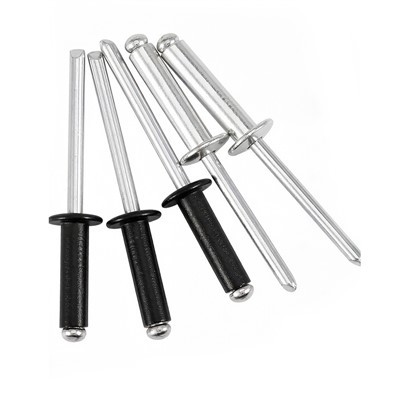
  • Blind Rivets

    Blind Rivets

    We take a φ5 mm stainless steel/stainless steel blind rivet as an example. It joins two 2 mm thick aluminum sheets. We follow ISO 14589 for testing. The ultimate shear force is ≥2.5 kN. The ultimate

    Add to Inquiry
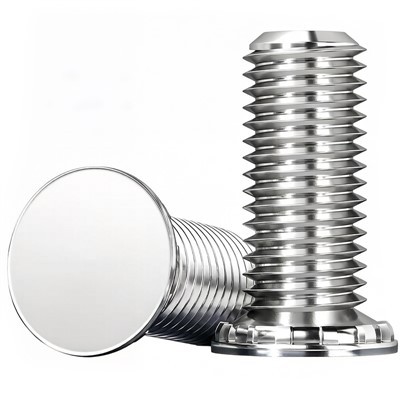
  • Press-fit Screws

    Press-fit Screws

    We take an M5 carbon steel press fit screw as an example. We press it into a 1.5 mm thick SPCC steel sheet. The needed press force is about 4-6 kN. After installation, the push-out force is ≥250 N.

    Add to Inquiry
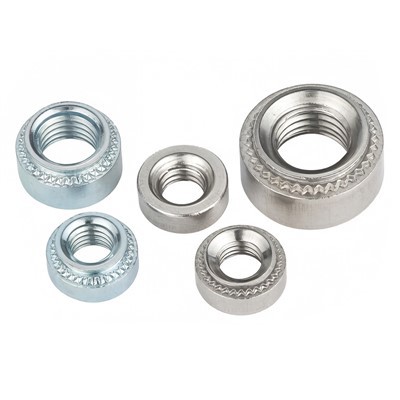
  • Press-fit Nuts

    Press-fit Nuts

    We take an M4 stainless steel press fit nut as an example. We press it into a 1.2 mm thick SECC zinc coated sheet. The needed press force is about 2.5-4 kN. After installation, the push-out force is

    Add to Inquiry
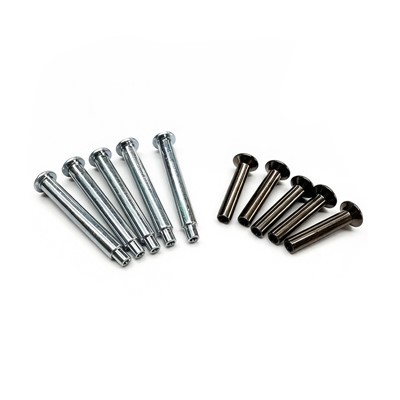
  • Special Rivet

    Special Rivet

    We take a φ5×12 mm semi-hollow rivet as an example. The hollow depth is 6 mm. The wall thickness is 0.8 mm. The joint strength after riveting is ≥1.5 kN. This works for luggage pull rods or hinge

    Add to Inquiry
  • Pull Rivets

    Pull Rivets

    We take an M6 stainless steel pull rivet as an example. We put it into a 1.5 mm thick SPCC steel sheet. The drill hole is φ8.5 mm. The needed pull force (installation force) is 8-12 kN. After

    Add to Inquiry
 

Product Types & Categories


01
 

Solid and Semi-Tubular Rivets

Solid Rivets: Available for applications requiring permanent fastening, subject to the specified material, dimensions, and joint design.
Semi-Tubular Rivets: Feature a partially hollow shank that facilitates tail formation during installation.

 
02
 

Blind Rivets (Pop Rivets)

Open-End Blind Rivets: General-purpose options for sheet metal and component assembly.
Closed-End Blind Rivets: Designed to reduce the passage of fluids or gases through the rivet body. Actual sealing performance depends on the rivet design, installation conditions, and joint configuration.

 
03
 

Structural Blind Rivets

Interlock and External-Locking Designs: Use defined locking mechanisms to retain the mandrel after installation.
High-Clamping and Bulbing Designs: Form a larger blind-side bearing area to distribute clamping force across the joined material.

Blind Threaded Rivnut Fasteners


Custom Rivet Manufacturing

Non-Standard Dimensions:

Custom shank lengths, grip ranges, step-shank configurations, and flange diameters up to 30 mm, subject to tooling and manufacturing feasibility.


Special Materials:

Options may include 7075 aluminum, Monel 400, or selected high-temperature stainless steels, subject to forming characteristics, product design, and confirmed manufacturing capability.

Pre-Applied Sealing Components:

Under-head washers, elastomeric seals, or other specified components may be evaluated for compatible designs.

Custom Shank Configurations:

Grooved shanks, knurled bodies, and split-tail designs may be considered for specific substrate and retention requirements.

Drawing Review:

Submit 2D drawings or 3D CAD models with critical dimensions, tolerances, material requirements, surface finishes, and installation conditions for a manufacturability review.


Specifications & Options


Parameter

Specifications & Options

Diameter Range

2.4–12.0 mm (3/32–1/2 in), subject to rivet type and design

Grip Range

0.5–30.0 mm, depending on product design; custom grip lengths subject to engineering review

Head Styles

Dome, large flange, countersunk (90°, 100°, or 120° where applicable), flat head, and truss head

Carbon Steel

SAE 1008, 1010, and 10B21, subject to product and process suitability

Stainless Steel

Grades 304, 316, and 430, subject to the selected rivet design

Aluminum Alloys

5050, 5052, 5056, and 6063, subject to product availability

Other Materials

Copper and brass for selected rivet applications

Surface Finishes

Trivalent zinc plating (Cr3+), clear/yellow/black where available; zinc-nickel plating; anodizing for suitable aluminum parts; stainless steel passivation; and organic Geomet/Dacromet coating systems

Applicable Standards

DIN 7337, IFI-114, applicable parts of ISO 15977–ISO 16585, and ANSI/ASME B18.1.2, subject to the specific rivet type and dimensional requirements

Quality Documentation

Inspection reports, material documentation, and customer-specific quality records as agreed for the order


Manufacturing & Quality Control


A controlled production process helps identify dimensional and material deviations before shipment. The applicable inspection plan should be agreed according to product type, order volume, customer specifications, and the consequences of joint failure.
Manufacturing Workflow
Wire or raw-material verification → Cold heading or forming → Secondary machining and slotting, where required → Dimensional inspection and sorting → Surface treatment → Final inspection and packaging.

Inspection and Testing
Optical Sorting: Automated vision systems can inspect defined characteristics such as body diameter, head dimensions, visible defects, and mandrel presence, depending on the machine configuration and inspection program.

Tensile and Shear Testing: Mechanical tests can be specified to evaluate rivet performance using the applicable product standard or customer-defined method.

Dimensional Inspection: Calipers, micrometers, optical comparators, and other suitable measuring instruments can be used to verify critical dimensions.

Thread Inspection: Threaded rivet nuts can be checked using appropriate thread gauges and dimensional inspection methods.

Hardness Testing: Rockwell or Vickers testing may be applied where relevant to the material and product specification.

Corrosion Testing: Salt-spray testing can be arranged where required by the agreed coating specification and acceptance criteria.


Blind Threaded Rivnut Fasteners


Quality Systems and Documentation

The following should be provided according to actual certification status and customer requirements:
ISO 9001 or IATF 16949 certification, where applicable to the manufacturing site and production scope.

First-article or dimensional inspection reports.

Material certificates and batch traceability records, where available and specified.

PPAP documentation for applicable automotive programs.

RoHS and REACH compliance documentation for relevant products and substances.

Optical sorting or other inspection records when included in the agreed quality plan.


Applications
 

Automotive and Commercial Vehicles:

Body panels, seating structures, trailer panels, and selected chassis or battery-enclosure assemblies, subject to the design and validation requirements.

HVAC and Sheet Metal:

Ductwork, air-handling equipment, electrical cabinets, and metal enclosures where one-sided access may be required.

Electronics and Appliances:

Internal frames, equipment panels, and component mounting points. Electrical bonding applications require suitable joint design and verification.

Solar and Renewable Energy:

Selected mounting structures, equipment housings, and inverter cabinets where the rivet material, coating, and load requirements


OEM Orders & Export Supply


Production Capacity: The supplied company information states a combined capacity of up to 80 million pieces per month across 12 automated cold-heading lines. Confirm current operating capacity, product mix, and available production allocation before publishing this figure as a firm supply commitment.


Automotive Documentation: PPAP documentation, IMDS-related information, material records, and compliance documents can be supplied where applicable and agreed for the program.


Packaging Options: Bulk cartons, labeled inner boxes, custom barcode or QR identification, and tape-and-reel packaging where compatible with the product and automated installation process.


Logistics: FOB, CIF, DDP, or EXW may be considered subject to the shipment route, destination, contract terms, and the seller's ability to provide the selected service.


Recurring Orders: Scheduled deliveries and buffer-stock arrangements can be evaluated for repeat orders according to demand forecasts and agreed inventory terms.


FAQ


Q: What is the difference between standard blind rivets and structural blind rivets?

A: Standard blind rivets are used for general fastening applications within their rated performance range. Structural blind rivets are designed for specified load-bearing joints and may include a mandrel-locking mechanism. Compare the relevant tensile and shear data, grip range, installation requirements, and joint design before selecting a product.

Q: How do I choose the correct rivet grip range?

A: Measure the combined thickness of all materials being joined and select a rivet whose specified grip range covers that thickness. Also verify the required hole diameter, material combination, head style, and installation tool. The manufacturer's installation data should be used to confirm suitability.

Q: Can you supply rivets for automotive programs requiring PPAP?

A: PPAP documentation can be evaluated for applicable automotive programs, subject to the supplier's actual quality-system scope and the customer's requirements. Confirm the required PPAP level, submission contents, traceability expectations, and approval process before placing the order.

Q: Can your rivets meet a 1,000-hour salt-spray requirement?

A: Suitability depends on the base material, coating system, pretreatment, test conditions, and the customer's acceptance criteria. Specify the required exposure duration and whether acceptance is based on white rust, red rust, or another criterion. Any compliance claim should be supported by relevant test evidence for the specified coating system.

Q: How can rivet dimensions affect automated installation?

A: Variations in body diameter, length, head geometry, mandrel dimensions, or surface condition can affect feeding and installation. Define the critical dimensions and inspection criteria for the application. Optical sorting may be used for selected measurable characteristics when the inspection system is validated for those features.

Q: What information is required to quote custom rivets?

A: Provide the rivet type, engineering drawing or CAD file, diameter, length, grip range, material, surface treatment, joint material and thickness, required standards, estimated order quantity, and target delivery date. Include any required inspection reports, mechanical test criteria, or compliance documentation.


modular-1
Request a Technical Quote or Samples

Send your drawings and application requirements for technical review and quotation.
Tel: +86-21-51805738
E-mail: liujingshco@163.com

Please include:
Engineering drawings: PDF, DWG, STEP, or another agreed format.
Rivet specifications: Type, diameter, length, head style, and grip range.


As one of the most experienced riveting manufacturers and suppliers in China, we have world-leading production equipment and strong manufacturing capabilities. Please rest assured to wholesale bulk riveting made in China here and get quotation from our factory. Customized orders are welcome.

Press fit Screws, Pull Rivets, riveting
goTop

(0/10)

clearall
