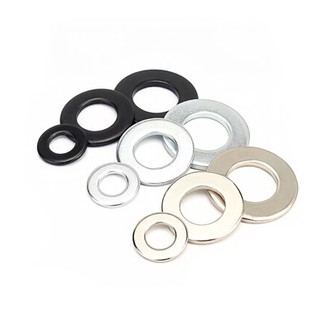

Gaskets are classified into three major categories based on their constituent materials: non-metallic, semi-metallic, and metallic gaskets.
Non-metallic Gaskets
Non-metallic gaskets are characterized by their soft texture, corrosion resistance, and low cost; however, they exhibit poor resistance to high temperatures and pressures. They are predominantly used for flange sealing in medium-to-low pressure vessels or pipelines operating at ambient to moderate temperatures. Examples of non-metallic gaskets include rubber gaskets, asbestos gaskets, asbestos-rubber gaskets, flexible graphite gaskets, and PTFE (polytetrafluoroethylene) gaskets.
Semi-metallic Gaskets (also known as Metal-Composite Gaskets)
While non-metallic materials offer advantages such as excellent flexibility, compressibility, and suitability for low bolt loads, their primary drawbacks are their relatively low strength and poor resilience, rendering them unsuitable for high-pressure and high-temperature applications. Consequently, semi-metallic gaskets were developed to combine the strengths of both material types-specifically, the high structural strength, superior resilience, and high-temperature tolerance characteristic of metallic materials-resulting in a composite structure that leverages the best features of both components.
Metallic Gaskets
Under harsh operating conditions-such as high temperatures, high pressures, and frequent load cycling-various metallic materials remain the preferred choice for sealing gaskets. Commonly used materials include copper, aluminum, low-carbon steel, stainless steel, and chromium-nickel alloy steel. To minimize bolt loads and ensure a compact structural design, flat metallic gaskets are typically designed with a narrow width whenever possible; furthermore, various types of ring gaskets featuring line-contact sealing characteristics are often the preferred structural form.
Flat Metallic Gaskets
When utilized in a flat configuration, these gaskets are broadly categorized into two types: wide gaskets and narrow gaskets. Wide gaskets require substantial pre-tightening forces, which can easily induce deformation in the bolts and flanges; consequently, they are rarely used on smooth-faced flanges in applications where the operating pressure exceeds 1.96 MPa. Narrow gaskets are easier to pre-tighten and are suitable for use in pipelines operating within a pressure range of 6.27 to 9.8 MPa.
Corrugated Metallic Gaskets
Corrugated metallic gaskets are typically fabricated from metal sheets with a thickness ranging from 0.25 to 0.8 mm. The overall thickness of the finished gasket generally corresponds to 40% to 50% of its wave pitch (wavelength). These gaskets are well-suited for use on smooth sealing surfaces and in pipelines operating at pressures up to 3.34 MPa.
Serrated Metallic Gaskets
Serrated metallic gaskets are predominantly utilized in pipelines operating within a pressure range of 6.77 to 9.8 MPa. The tooth pitch is approximately 1.5 mm, and both the tooth crest and root angles are 90 degrees. Its sealing performance is superior to that of flat gaskets, and it requires less clamping force.